The photograph arrived at 6:14 on a Monday morning. Tunde had placed his new humidor on a cleared section of his sideboard, angled it towards the light, and taken the picture with the care people usually reserve for newborn children.
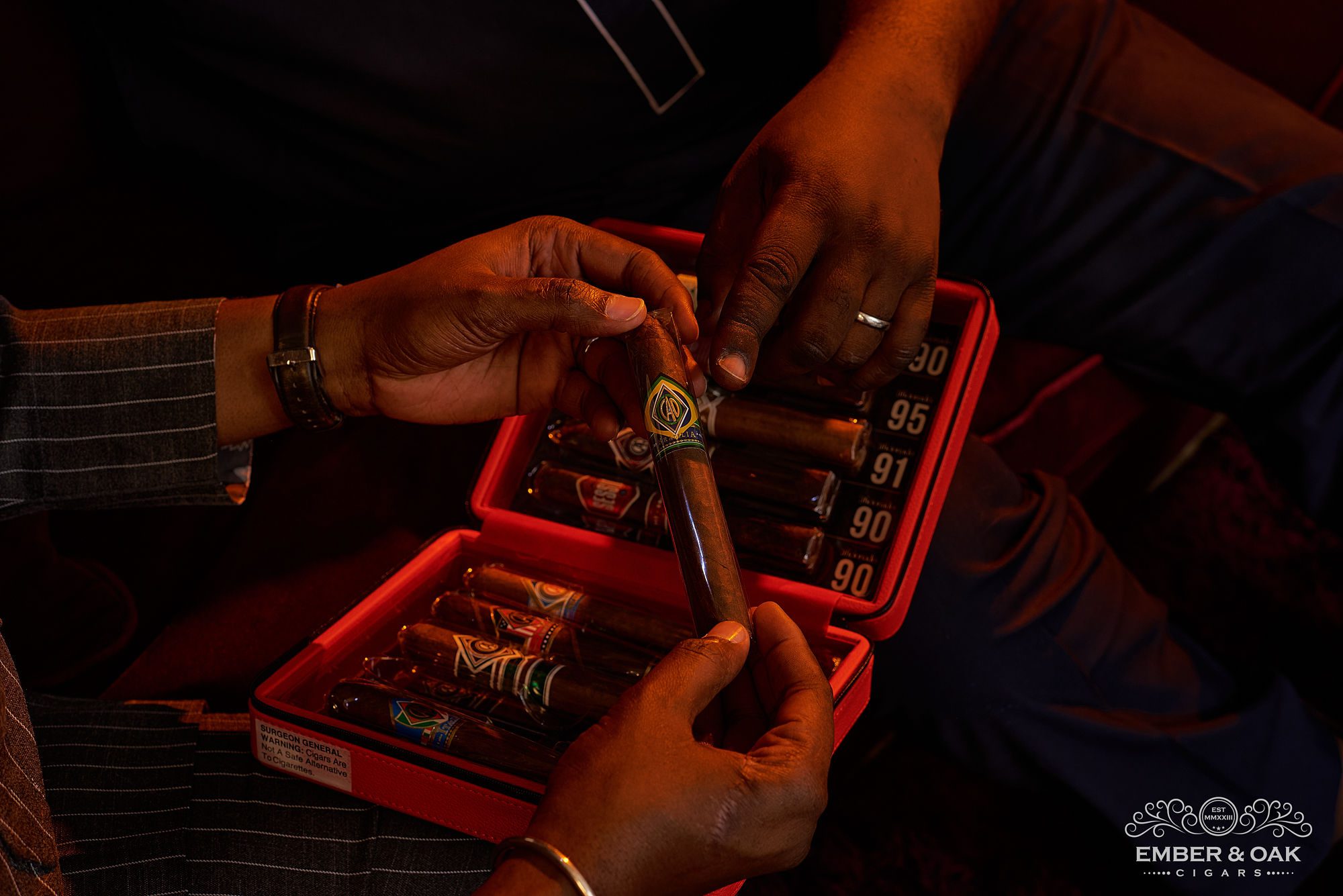
The lid was open Inside, there was nothing.
His message underneath read: “We have a problem.”
I was still looking at the photograph when a second message arrived.
“Too much space. We need to fill this thing.”
Three months earlier, he had wanted somewhere to ask a stupid question. Now he wanted a collection.
I put down my coffee and called him.
“Good morning, Collector.”
He laughed. “Don’t start. I’m serious.”
“So am I. What do you want to put in it?”
“That’s why I’m calling you.”
Then, after a pause: “But something respectable.”
I looked again at the empty humidor. It seemed we had found the next thing to talk about.
The Committee in His Pocket
By the time Tunde came into Ember and Oak Cigars that afternoon, he had a list.
It was not a shopping list so much as a meeting of several people who had never met one another. A friend in Abuja had nominated two cigars. Someone from a birthday gathering had insisted on another. A collector he followed online had declared a particular release “essential”, and a WhatsApp group had spent most of Sunday arguing about what a serious collection ought to contain.
Tunde had copied all their suggestions into his phone.
“This one is apparently a must-have,” he said.
“Have you tried it?”
“No.”
“What appeals to you about it?”
He scrolled upwards, looking for the answer.
I waited.
“They said it’s difficult to find.”
“And this one?”
“That’s the one collectors respect.”
“Do you think you would enjoy it?”
He lowered the phone. “You are making this thing difficult.”
Behind us, another customer was asking whether a small humidor would survive her sitting room, which faced the afternoon sun. I remember thinking she had asked the more useful question.
I asked Tunde to show me his own notes instead.
There they were, beneath the screenshots and recommendations: a few short entries from evenings he had actually enjoyed. One mentioned a gentle beginning. Another said he would happily have the same cigar again. There was still the note from Bisi’s birthday, which recorded almost nothing about the cigar and quite a lot about the evening.
“Why aren’t these on your list?”
He looked down for a long moment.
“They didn’t feel like collection cigars.”
“What made them evening cigars but not collection cigars?”
“I don’t know. They’re just the ones I like.”
I pulled his chair closer to the counter. We finally had a starting point.
The Budget Nobody Else Could See
Before we chose anything, I asked what he wanted to spend.
He gave me a number, watched my face, then immediately increased it.
“Actually, I can stretch.”
“You haven’t seen anything yet.”
“I know. But if there’s something special.”
I asked him to put the phone away.
Tunde was doing well enough in business, but doing well and having nothing else to pay for were different conditions. A customer owed him money. One of his delivery vehicles needed attention. His younger sister had sent him a message that began with “Brother, please” and was unlikely to end cheaply.
He told me all this with the apologetic air of someone explaining why he should not be allowed nice things.
“I didn’t ask you to defend your budget,” I said. “I asked you to choose one.”
He leaned back.
Outside, someone sounded a horn for so long that we both stopped speaking until it ended.
“The first number,” he said eventually. “Let’s stay with the first number.”
We wrote it down.
It changed the afternoon. Instead of reaching for every interesting possibility, we began deciding what deserved a place.
He chose a few cigars he already knew he liked. We left room for a small amount of exploration, including something he had been curious about before anybody told him it was important.
Then I stopped.
Tunde looked at the selection. “That’s all?”
“That’s what we’ve chosen.”
“The humidor will still look empty.”
“Some of it will.”
He glanced at the photograph again. I could see him imagining the lid opening in front of a visitor, followed by the small, terrible silence in which he might have to explain why he did not own more.
“Who are you expecting to inspect it?” I asked.
He smiled, but did not answer.
We packed his choices without filling the remaining space.
The Purchase He Did Not Mention
For two weeks, Tunde was pleased with himself.
He sent me short updates, asked a few questions, and began referring to the humidor as “my small corner”. Then he went quiet.
On Saturday, he arrived at the terrace carrying a cigar case and the expression of a man hoping nobody would ask what was inside.
Bisi asked immediately.
He opened it.
Emeka adjusted his glasses. “Ah. You have been shopping.”
It was a cigar Tunde had seen repeatedly in the collectors’ group. He had bought several after a conversation in which somebody used the phrases “last chance”, “serious people”, and “you’ll regret missing it” close enough together to trouble his judgement.
“Did you try one before buying the others?” I asked.
He shook his head.
“But everybody said it was excellent.”
We left it there. He had not come for a tribunal.
Later in the evening, I asked how he was finding it.
“Very good,” he said quickly.
Bisi looked at him over her glass.
“You have made that face three times.”
“Which face?”
“The one people make when the wedding photographer says there are only two more pictures.”
Emeka laughed. Tunde tried to laugh with him, then put the cigar down.
“It’s not for me,” he admitted.
Nobody rushed to contradict him.
He explained what he disliked as best he could. There was nothing wrong with his description; he simply sounded disappointed that his own experience had failed to match the applause on his phone.
“Maybe I don’t understand it yet.”
“Perhaps you’ll feel differently another day,” I said. “But you don’t have to claim you like it tonight.”
He looked at the case.
“I bought more than I should have.”
There was a small silence. Then Emeka took off his glasses.
“I once bought a pair of shoes in Milan that I could not walk in.”
Bisi turned towards him. “Once?”
“Please allow me to help the young man.”
We laughed, and Tunde finally laughed properly too.
The mistake did not need a grand rescue. He had spent money on something that did not suit him, and he could admit it without becoming the evening’s fool.
Before he left, he opened his notes and wrote a new line.
“Try it myself first.”
The Ones He Was Saving
A month later, I visited Tunde at home.
He had invited a few of us for a late Sunday lunch. There was rice, stew, a bowl of pepper sauce that required its own conversation, and enough food to suggest his definition of “a few people” had been reviewed by an anxious auntie.
After lunch, he showed me the humidor.
It was no longer empty, but it was not crowded either. He knew what he had chosen and could tell me why most of it was there.
Then he pointed to a small group set apart from the rest.
“Those are for an occasion.”
“Which occasion?”
“A proper one.”
“Such as?”
He considered it.
“A big contract. My birthday. Something.”
I recognised the tone. I had used it myself.
There was a time when I saved certain things so carefully that I began to suspect I enjoyed the idea of eventually enjoying them more than I trusted any actual day to deserve them.
I told him about a bottle I had once kept waiting for the right gathering. Several good gatherings had passed while it remained unopened.
“What finally happened?”
“A friend asked why I kept telling him about it instead of pouring it.”
Tunde smiled and closed the lid.
I did not ask him to open anything. A collection was still his own, including the things he wanted to keep.
Outside, Bisi was arguing with her husband about which of them had given the driver the wrong address. Emeka had found a comfortable chair and was pretending not to be asleep.
Tunde stood listening for a moment.
Then he opened the humidor again.
“Actually,” he said, “today is quite a good day.”
A Collection With Other People in It
There was no announcement when he brought his choices outside.
He did not tell us how difficult anything had been to find, or explain what the afternoon would have cost in a lounge. He simply asked who wanted to join him and made sure everyone had somewhere comfortable to sit.
Bisi chose something familiar.
“That one again?” Tunde asked.
She raised an eyebrow.
He held up his hands. “Sorry. I heard myself.”
Her husband declined a cigar and asked for more water. Tunde brought it without trying to persuade him, and he stayed for the conversation as he always did.
For a while, we talked about nothing anybody would have thought to put on an invitation: a neighbour’s impossible parking, a school reunion, whether Emeka truly knew the best place for suya or simply the owner.
Then Tunde’s phone rang.
It was the customer who owed him money.
He looked at the screen, excused himself, and went inside. Through the open door, we could hear his voice become careful and professional.
When he returned, the payment was still promised rather than received.
“Tomorrow,” he said, settling into his chair. “Tomorrow has been working very hard for that man.”
Nobody told him to be grateful or to forget his problems. Bisi asked one sensible question, Emeka offered an experience of his own, and after a while the conversation moved elsewhere.
The afternoon did not fix his business. It gave him somewhere he did not have to pretend the business was effortless.
Much later, while we were helping carry plates inside, he stood beside me at the sink.
“I nearly kept those cigars for another day.”
“You could have.”
“I know.” He rinsed a plate and passed it to me. “I’m glad I didn’t.”
What Belonged in the Space
The next photograph arrived several weeks later.
Same sideboard. Same humidor. Less careful lighting this time, and the corner of a laundry basket visible in the frame.
There were spaces where cigars had been.
His message read: “Finished the familiar ones. I’d like a few more of those when I next come in.”
Then another message.
“No rush on the rest.”
I enlarged the photograph.
His collection would not have silenced a room full of collectors. There was no attempt to represent every country, satisfy every recommendation, or prove that he could afford to make mistakes in quantity.
But it was becoming recognisably his.
He had room for what he liked, room to be curious, and room to change his mind. Some choices were connected to friends now, and a few empty places marked afternoons that had actually happened.
When Tunde next came into the shop, he brought his list. It was much shorter.
We chose what he had come for. He asked about one unfamiliar cigar, listened, and decided he would leave it for another time.
At the counter, I asked whether the empty spaces still bothered him.
He looked at me as if he had forgotten they once had.
“No,” he said. “I know what I’m waiting for now.”
“What?”
“Something I want. Not something I’m supposed to want.”
He tucked the small purchase into his bag and checked his phone. Bisi had sent a message to the group about the weekend, and Emeka was already disputing the location.
Tunde began typing before he reached the door.
I watched him leave with fewer cigars than his humidor could hold and plans to see people he had not known six months earlier.
That evening, when I checked our own humidor, I noticed a gap on one of the shelves. For once, my first thought was not about what needed replacing.
I wondered who had enjoyed what used to be there.
The Founder, Ember and Oak Cigars, Lagos
The Ember and Oak Chronicle: The Empty Spaces