Finding Your Smoke, Finding Your People
The first thing Tunde asked me was not the price. It was whether we had somewhere he could ask a stupid question.
He said it quietly, standing in our corner of Adam and Eve Luxury Homeware, with one hand in his pocket and the other holding a phone full of screenshots. Behind him, a woman chose between two lamps with the confidence of someone who knew exactly what she wanted.
Tunde watched her for a moment. “Even that woman understands her own market,” he said. “Me, I have been researching cigars for three weeks. I think I know less now.”
He was thirty-six. He ran a procurement business, had survived a warehouse flood, and could negotiate with a supplier who changed his price halfway through unloading a truck.
But put him in front of a humidor and he became a schoolboy whose name had just been called.
I pulled out a chair. “Start with the question.”
He sat down, leaned towards me, and lowered his voice further.
“When people say they taste chocolate in a cigar, are they telling the truth?”
The Chocolate That Refused to Arrive
His first cigar had been at a birthday gathering in Lekki. Someone had passed him a stick, someone else had cut it, and a man wearing a watch that kept catching the light had announced that he was getting dark chocolate, leather, and a long finish of roasted almonds.
Tunde had nodded. He was getting smoke.
Then the man had turned to him. “What are you picking up?”
There are moments when a person can feel every school examination, they ever sat returning at once. Tunde had looked at the cigar, searched his entire childhood for an almond, and said, “The chocolate is definitely there.”
It was not there. Not for him.
For three weeks afterwards, he had wondered whether his tongue was the problem.
“What were you expecting?” I asked him.
“Chocolate,” he said. “Actual chocolate. Otherwise, why are we calling it chocolate?”
I laughed, and after checking that I was laughing with him, he did too.
“Tell me what it reminded you of instead.”
He thought for a while. “The smell of the wooden cupboard in my father’s sitting room. Before my mother replaced it.”
“Then I would rather hear about that cupboard.”
He looked surprised. Apparently, no one at the birthday had offered furniture as an acceptable answer.
I explained that I wanted his description, not a borrowed performance. If something reminded him of toast, he could say toast; if all he could confidently say was that he liked the beginning more than the end, that gave us somewhere to start.
“And if I don’t taste anything interesting?”
“Then don’t invent something interesting on my behalf.”
His shoulders dropped a little. We had not opened the humidor yet, but already the visit was going better than the birthday.
The Strongest Man at the Table
His next question came more confidently. “Fine. Give me something strong. Let me start properly.”
I asked him what “properly” meant.
He gestured vaguely towards the larger cigars. “Something serious. I don’t want the beginner one that I’ll have to abandon after two weeks.”
There it was: the fear that even enjoyment came with a junior position, and that everybody would know how long you had occupied it.
“Do you order the hottest pepper soup every time you go out?” I asked.
“Depends on who cooked it.”
“Not on whether the next table will respect you?”
He smiled. “Okay. I hear you.”
We separated two things he had been treating as one: how much flavor he wanted and how strong he wanted the cigar to feel; a cigar could offer a substantial flavor experience without equally forceful strength.
For his first choice with us, I suggested something on the milder side rather than the most forceful option in the cabinet.
“And when do I move up?” he asked.
“If you find something else you prefer, we explore it. But you don’t owe anybody a stronger cigar.”
Just then, Emeka arrived to collect a purchase he had put aside earlier that week. He was in his fifties, wore reading glasses on a cord, and had the unhurried manner of someone who had already spent enough years rushing.
He heard the end of our conversation and looked at Tunde.
“Move up to where?”
Tunde laughed. “That’s what I’m trying to find out.”
Emeka pointed to his own selection. “I’ve been enjoying that one for years. Apparently, I have refused promotion.”
It was the first time I heard Tunde laugh without immediately looking around to see who had noticed.
A Cigar Is Also an Appointment
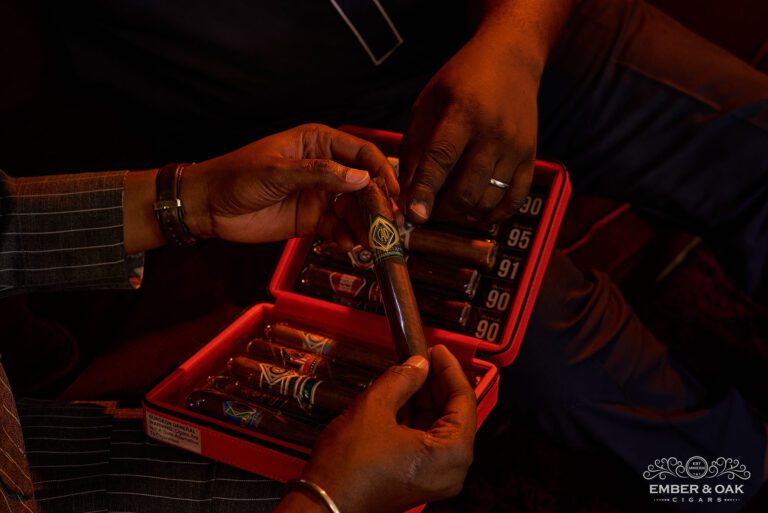
We put three different formats in front of him. He reached for the longest, paused, and looked suspiciously at Emeka.
“You people will say I’m trying to impress somebody.”
“Perhaps you just like it,” I said. “How much time do you have?”
“Today? Forty minutes. Maybe less. I still must get to Surulere.”
“Then let’s choose for the afternoon you actually have.”
We talked about size as a practical choice: length and thickness influence the time a cigar asks of you, while a larger cigar is not automatically a stronger one. (The Cigar Store’s guide to size and strength)
He tried the unfamiliar words aloud. Corona. Robusto. Toro.
“These sound like three people I owe money.”
Emeka said he would avoid Toro, then. It sounded like the one who would come to the office.
For once, the names were making Tunde laugh instead of making him feel excluded.
We settled on a modestly sized option from the milder choices we had discussed. Before I wrapped it, he checked the price twice, then admitted he had expected me to steer him towards something much more expensive.
“You told me your budget.”
“Yes, but this is Lagos.”
“Your budget is still your budget in Lagos.”
He bought one cigar, not a box. He also accepted an invitation to a small gathering on a friend’s open-air terrace that weekend, where some of our adult regulars occasionally met.
At the door, he turned back. “What should I bring?”
“Yourself. You can leave the screenshots.”
The Table Where Nobody Was Examining Him
On Saturday, Tunde arrived carrying the cigar, a cutter still in its packaging, and the careful expression of someone attending a wedding where he knew only the groom.
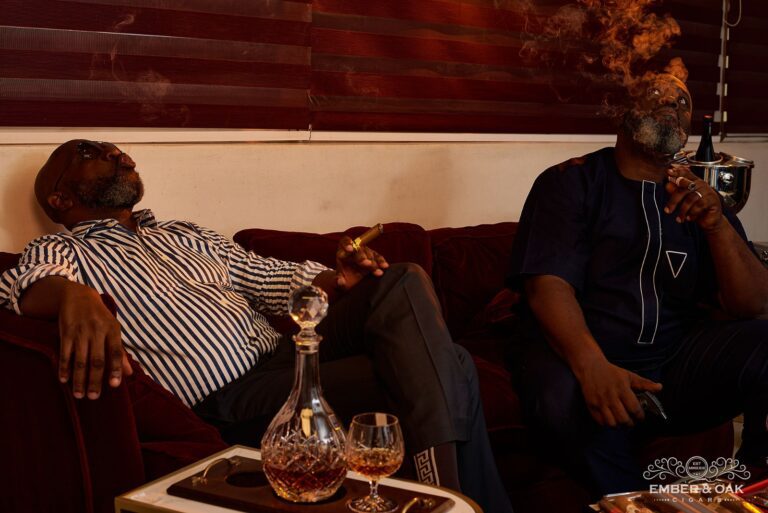
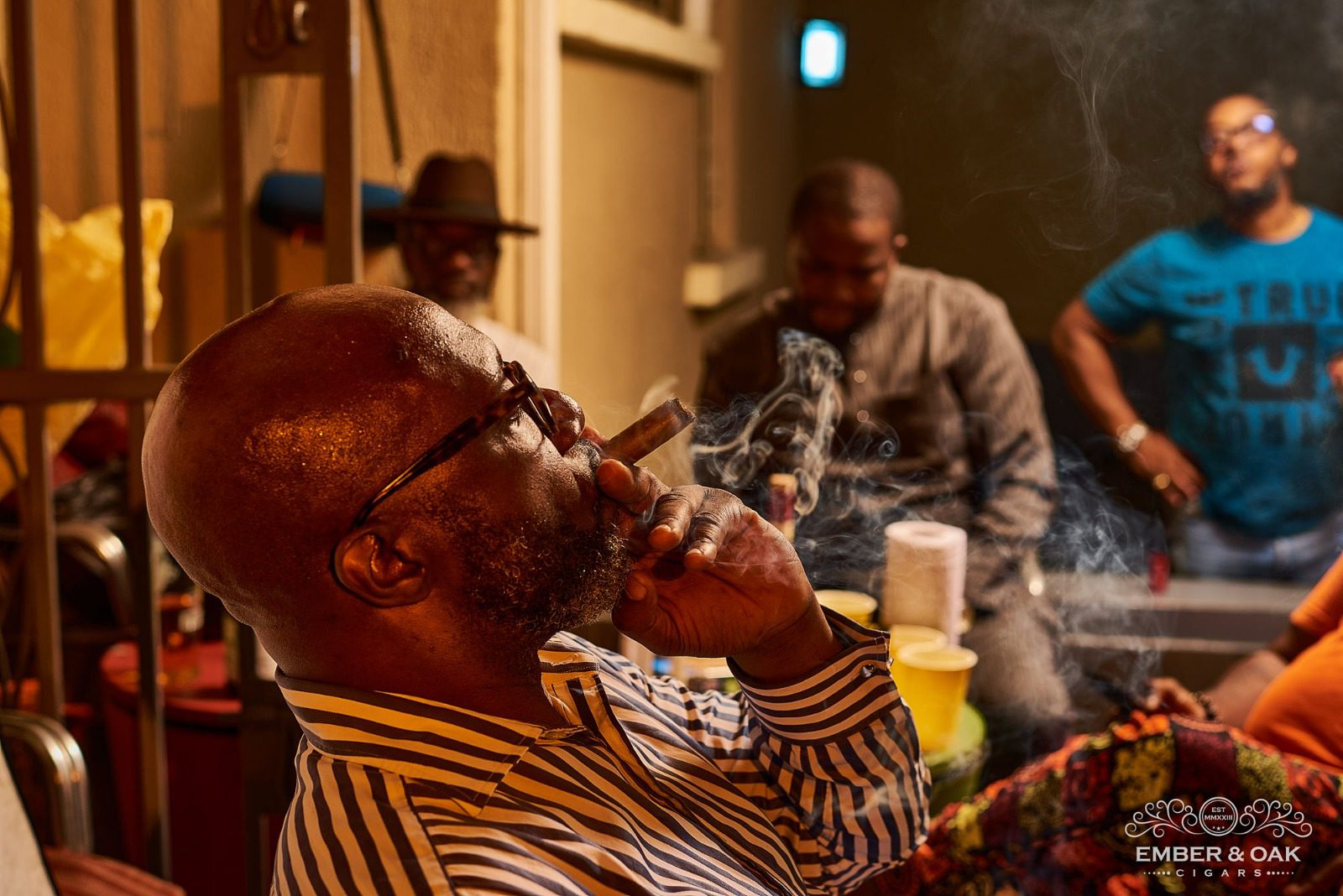
There were six of us. Chairs did not match, the plantain had disappeared faster than expected, and Bisi was accusing Emeka of telling a story differently from the last time.
“Last month, the customs officer was your cousin.”
“I said he knew my cousin.”
“Your stories need an auditor.”
“That is why we stopped inviting accountants.”
Bisi, who was an accountant, moved the remaining plantain away from him.
I introduced Tunde. Nobody asked what he drove, and nobody examined his cigar before deciding whether he belonged.
He sat beside Bisi, who noticed the unopened cutter.
“Would you like a hand?”
He nodded so quickly that she smiled.
“You could have asked.”
“I didn’t want to interrupt.”
“You heard that story. It needed interrupting.”
Later, after we had helped him get settled, he kept looking at his cigar as though it might be instructions. He checked the ash, checked ours, then checked his again.
“You can talk to us,” Bisi said. “It will still be there.”
He put his phone face down.
The conversation wandered from a difficult client to a father who refused to retire, then into disagreement about whether somebody’s wedding jollof had justified the journey to Epe.
Tunde forgot to compare his progress with everyone else’s.
Then, halfway through a story, he stopped.
“Groundnut.”
We looked at him.
“There’s something reminding me of groundnut. Not sweet groundnuts. The skin, maybe.”
“Write it down if you want,” I said.
He considered this, then shook his head. “Later. Finish the story first.”
I liked that answer more than any tasting note he could have given me.
Permission to Put It Down
The evening was not a transformation scene. Tunde did not suddenly discover seven flavors, produce a perfect column of ash, or become the most interesting man on the terrace.
His cigar went out while he was explaining a supplier dispute. He apologized for it.
Bisi laughed so hard that she had to put down her glass.
Later, he stopped enjoying it.
I could see him negotiating with himself. There was still some cigar left; he had paid for it; other people were continuing.
“I think I’m done,” he said eventually. “But I don’t want to waste it.”
“Then leave it,” I told him. “You don’t have to finish for our benefit.”
“Nobody will complain?”
Emeka looked around the table. “Who is collecting the unfinished ones for marking?”
Tunde set it down. Bisi offered him water, and the conversation carried on without the slightest sense that he had failed to complete his part of the evening.
We made something else clear that night: feeling unwell was a reason to stop, not a challenge to endure. Nobody at our table needed to prove toughness with tobacco.
When the plates were cleared, Tunde was still there. His cigar was finished as far as he was concerned, but he wanted to hear how Bisi’s father had accidentally joined a family video call with a saucepan in his hand.
That was the part he had not expected. Putting down the cigar did not mean losing his place.
Learning Without Turning Pleasure into Homework
Over the next few months, Tunde tried different choices when he felt like it. Some he liked immediately, one he found too forceful, and another he admired mostly because it taught him what he did not want to buy again.
He started keeping brief notes on his phone.
“Liked this after lunch.”
“Too much for me.”
“Try again when I’m not answering work calls.”
One entry simply read: “Bisi’s birthday. Good evening. Ask Emeka what this was.”
There were no scores out of a hundred. He was building a record of his own preferences, not preparing evidence for a panel.
Sometimes he came to Ember and Oak with a question about a blend. Sometimes he came because he was nearby and wanted to say hello.
His choices did not grow steadily, larger, stronger, or more expensive. What changed was that he could explain what he wanted without apologizing.
“Something familiar today,” he would say. Or “I feel like trying something different but keep it within this budget.”
On the terrace, he and Emeka discovered that they supported rival football clubs. Their friendship survived this, though several voice notes suggested it might not.
Bisi introduced him to her husband. Tunde helped another regular think through a delivery problem, then refused to let the next gathering turn into a procurement consultation.
“Please,” he said, putting his phone away. “I have come here to be a human being.”
Nobody could improve on that.
Pull Up a Chair
A few months after Tunde’s first visit, a new guest joined us on the terrace. He stood beside an empty chair, holding his cigar carefully and waiting for a break in the conversation.
I recognised the expression before he spoke.
“Sorry,” he said. “I’m new to all this. I don’t really know what I’m supposed to taste.”
Tunde moved his glass to make room.
“Neither did I.”
“But you understand it now?”
“Small-small,” he said. “Sit down.”
The newcomer sat. Tunde asked his name before he asked what he was smoking.
Watching them, I remembered the man who had walked into the shop with three weeks of research and nowhere to put his uncertainty. He had wanted the correct cigar, the correct words, and some reassurance that nobody would discover he was a beginner.
What he had found was room to be one.
I still care about the leaf, the storage, the provenance, and all the details that first drove me to build Ember and Oak. But I have learnt to pay attention to another moment: the point at which a guest stops rehearsing what to say and joins the conversation.
That evening, the new guest asked about chocolate. Tunde looked across at me, and I knew he was remembering a wooden cupboard in his father’s sitting room.
“Tell us what you think,” he said. “You don’t have to agree with anybody.”
Then somebody passed the plantain, Emeka began a story we had almost certainly heard before, and Bisi leaned forward to check his facts.
The newcomer laughed. Before long, he was telling a story of his own.
And for a while, nobody was discussing cigars at all.
The Founder, Ember and Oak Cigars, Lagos